Monday, October 4, 2021

300 game reviews: a look back


I made it: 300 game reviews. What a great life accomplishment! Okay, you can stop laughing now.

To be honest with you, I wasn’t sure how long this would last as I have a notoriously short attention span. I started playing through my game collection and writing a review for each game I finished back in early 2015, which is over 6 years ago for anyone keeping track. And you know what? I still haven’t gotten tired of it. I’m going to keep going and going until I can’t go any further. 1000 reviews, 2000 reviews – you are going to have to pry the controller away from my cold, dead 90-year-old hands.

Until then, let’s just celebrate 300 in style as we break down some numbers.

This blog has been open for 2468 days. That averages out to a review every 8.2 days. Not too shabby. When you factor in my other blog posts (which increases my total from 300 to 408 when I count this one), the numbers show that I make a post every 6.05 days. It really doesn’t feel like I make a post that often, however my activity is generally pretty sporadic. I can go weeks or months without making a post and then knock out ten in a row. That’s just how averages work, people.

My most reviewed system is the PlayStation 4, with 59 game reviews. That’s pretty impressive considering technically the PS4 is the system that’s been in my possession the least amount of time compared to the other systems listed. Way to go, PS4! The PS3 is second with 43 reviews, the Genesis has 34, the NES has 27, and the PS1 has 21. So those are my 5 most reviewed systems. My least reviewed systems are the PC and the TurboGrafx-16 with only 1 review each. Womp womp.
 
Looking back at my “200th Game Review” post, my most reviewed systems at the time were the PS3 with 37 reviews, the PS4 with 33 reviews, the Genesis with 24, the NES with 17 and the PS1 with 16. So in my last 100 reviews, 26 of them were for the PS4, 6 were for the PS3, 10 were for the Genesis, 10 were for the NES, and 5 for the PS1. Interesting. I guess it is not too surprising I cranked out so many PS4 reviews seeing as how I had GameFly for several months during this time period and I took full advantage of the service to catch up on all the newer games I’d been neglecting.

The only system in my possession where I’ve reviewed 100% of the games I own for it is the Sega Saturn. I only own 10 Saturn games, and I’ve reviewed them all.

My most reviewed game franchises are:
11 games - Resident Evil
10 – Batman
10 – Star Wars
9 – Sonic (not counting Dr Robotnik’s Mean Bean Machine as a Sonic game)
9 – Mario
7 – Tomb Raider
7 – Final Fantasy
7 – Kingdom Hearts
7 – Castlevania
7 - Contra

I’m thinking to even things out I’ll be playing a Sonic and a Mario game soon to get them to 10 reviews.

I think I’ve done a pretty good job playing through the “all time classics” in my game collection. Mario 3, Ocarina of Time, Final Fantasy VII, Skyrim, etc. There are still some I haven’t tackled, however. Most notably: Super Metroid, Castlevania: Symphony of the Night, Half Life, the Mass Effect series, The Metroid Prime Series, Metal Gear Solid V: The Phantom Pain, Final Fantasy Tactics, and the Witcher 3. You can soon cross the Witcher 3 off that list, as I just started playing it about two weeks ago and I’m pretty deep into the game.

Other games I’ve been having the itch to play lately include: Sonic 3D Blast, Tomb Raider: The Last Revelation, Castlevania Bloodlines, Blazing Lazers, Mega Man Legends, the Earthworm Jim games, Vectorman 2, Lunar: The Silver Star Story, Aliens vs Predator for the arcade, Paper Mario, Quake 2, The Legend of Dragoon, some of the early Doom games, and Punch-Out!! Will I actually play any of these games anytime soon? Who knows. My mind changes like the wind. Just look back to when I first started this blog. It was my goal to marathon review every Mega Man game in order and I only made it through two of them, a year between reviews. 

Last thing before I end this, I want to bring up how I’ve been emulating games the last few months. Prior to figuring out how to emulate, I was always severely opposed to the idea. I was going to play through the games in my collection, and then (and ONLY then) would I turn to emulation in order to track down all the games I didn’t have in my collection or never had a chance to play growing up. Sorry to disappoint you, but I am weak. As soon as I figured out how to emulate, it was game over for me. I was hooked. I still plan to make it through my collection, it’s just going to take a little longer now because of all the detours I’m finding myself taking lately (if you want an example just look at all the arcade beat ‘em ups I’ve reviewed in recent weeks).

I thought I would find myself taking a morally opposed stance against emulating, but when you factor in the age of these games and the fact that they aren’t making their creators any money anymore, I really couldn’t care less. Bring it on!

This brings me to my next announcement: I’ve ordered a RetroPie online. It comes loaded with basically every video game released before the year 2000 (excluding Saturn titles because they are so hard to emulate). That’s something like 50,000 different games. You have NO idea how excited I am for this. Every retro game I’ve ever wanted to play in my life, right there are my fingertips. It sounds too good to be true. But it’s happening. Oh yes. It’s happening.

Be prepared for lots of fun reviews for games and systems I’ve never had the chance to play, REAL soon. I can’t wait. Just remember, when I hit 1000 total games played in my life, I plan to rank them all from worst to best. I’m at 877. I’ve been planning this for a while now. The RetroPie could make it happen a lot sooner. I’m so stoked!

If you want a complete index of all my past game reviews, follow the link below. It's always been my hope that a like minded nerd like me would stumble upon this blog someday and be blown away by all the content I have posted. I haven't really gone out of my way to promote this blog, but if it can help keep even one person entertained it is all worth it!


Video Game Review #300: The Simpsons

The Simpsons
Arcade


Nostalgia Factor:

I did it! 300 game reviews. And they said it couldn't be done. I decided to make my 300th review something special, for a game that I loved to play growing up and I also had an interesting history with as a kid.

The first time I ever played it was back when I was in 3rd grade. I had just started at a new school, and one of my classmates invited me to his birthday party at a nearby bowling alley. I remember all of us kids gathering around this machine, plugging in our quarters and having a fantastic time controlling Marge, Homer, Lisa, and Bart as we trounced through Springfield, beating the crap out of everyone in sight. We were all so incredibly in awe of this game and how faithfully it recreated the look and feel of the Simpsons. At the time, I don’t think I had ever been more impressed with an arcade game in my life.

I was on the far left hand side of the arcade cabinet, so I was in control of Marge. Normally I’d scoff at not being able to play as Bart, but Marge’s rangy vacuum cleaner attack more than made up for it. Around the cemetery level of the game, I ran out of quarters. There was another kid waiting his turn to jump in, but instead of doing so he put a quarter or two into the slot and told me to keep going. So I did. And he kept doing it. Quarter after quarter, he let me keep going.

The next day at school, I found out that this kid had complained to his parents and all the other kids at the party that I had “forced him” to put his money into the game and then I wouldn’t move over and let him play – essentially stealing his money and being a jerk to him in the process. Being the new kid at the school, this automatically cast me in a bad light with all the other kids (and their parents) and I was never invited to another birthday party again. Just another sad step down the path of being the angry loner kid I turned out to be.

Such fun memories.

Anyway, I did always like this game as a kid. I had the opportunity to play through it a few other times at different arcades, this time with enough quarters on hand to actually complete the game. Over the years this has gone down in my books as one of my favorite beat ‘em ups of all time. That said, I haven't played it in nearly 20 years. How would I feel about it now, in present day? Well, that’s what we’re here to find out.


Story:

This game has such a weird storyline, but I guess a beat ‘em up set in the Simpsons universe wouldn’t really work without a weird storyline in place. The game begins with Smithers (Mister Burns’ right-hand man) robbing a bank. Why Smithers is robbing a bank, I have no idea. Seems a little out of character to me, but whatever. On his way out the front door of the bank he runs head first into the Simpsons, flinging a jewel into the air which is recovered by Maggie Simpson, who sticks it in her mouth and sucks on it like a pacifier. Rather than grab the jewel away from her, Smithers grabs the whole baby and runs away, leaving the Simpsons to chase after him. In his wake the Simpsons have to fight against a nonstop wave of henchmen and criminal lackeys, presumably hired by Smithers and Mr Burns to assist in the robbery and subsequent getaway.

Chasing after Smithers, this game leads the Simpsons through a ton of fun Springfield locations, such as Moe’s Tavern, the news station, the cemetery, and a Krusty the Klown themed amusement park. There’s even a bizarre dream world you must fight your way through after your characters fall down a waterfall after a fight with a bear. Like I said, this game’s story is weird. Things finish up at Mr. Burns’ mansion, where you fight Smithers and Burns, who act as the game’s final bosses. Beat the bad guys, get the baby back.

Yay!!!

Like I said, there’s a lot of stuff about this game’s story that doesn’t make sense. Why are Smithers and Mr Burns robbing banks? Why is the entrance to Moe’s Tavern at the bottom of a hole in the cemetery? Why are we fighting zombies and bears? Where did they even come from? What happens to Homer's job after he just finished beating the shit out of his boss? Why are – yeah I could go on for a long time, but I won’t. This game’s story doesn’t matter much, and only serves a very loose reason as to why the Simpsons would have any reason to get into a giant brawl with like 90% of Springfield’s population.


Gameplay:

If you’ve played literally any beat ‘em up from this era, you know how this game works. You move from left to right. You operate on a 3D plane. You punch your enemies. You can jump into the air and attack them. Every once in a while you can pick up projectiles to throw at your enemies. You collect the occasional health item. There are environmental hazards. You fight a boss at the end of the stage. Blah blah blah. It seems like I’ve played a TON of beat ‘em ups lately (TMNT, Final Fight, Turtles in Time, Streets of Rage, etc), and this game does literally nothing that you haven’t seen in those games. I don’t feel like repeating myself so if you really don’t know how this type of game works, you can click a link to those reviews, which I’ll put at the bottom of this post. Happy? I hope so.

What sets Simpsons apart is… well, its theme. Just seeing the world of the Simpsons brought to life really gives this game a ton of personality and makes it super fun. I challenge anyone to pick up this game and have a bad time with it. I don’t think that’s possible. If I had to offer any complaints at all, I’d say that the game is a bit easy. The average enemy you fight is complete fodder, and they go down in just a couple of hits. The bosses are where this game gets challenging, but try as I might – I couldn’t really figure out any decent strategies from these battles aside from spamming my attack and my jump attack and taking my lumps as the enemy deals them out. These bosses become a war of attrition, designed to make you keep plugging quarter after quarter into the machine.

I understand this and I don’t hold it against the game, but it does make things seem a bit imbalanced when it comes to its difficulty level.


Graphics:

I already mentioned the theme of this game as one of its highlights. Let me go into greater detail.

The introduction. OMG, it is fabulous. It is just like the opening credits of a Simpsons episode, but it tells you a little bit about the characters and their strengths and weakness before you even play the game. The animation is spot on, and it really does a tremendous job capturing the feel of the show. Right off the bat, you know you’re in for something special.

The characters look fantastic – both the protagonists and the enemies. There is absolutely no mistaking who any of these characters are. And the world they inhabit is bright, colorful, and bursting with activity – like an episode of the show come to life. Just look at the very first stage, where you are walking down Springfield’s main drag. You see all kinds of businesses and shops in the background – and if you really pay attention you’ll notice a lot of fun little Easter eggs thrown in there. Krusty’s amusement park, the cemetery, Moe’s Tavern, the forest stage, the dream world, the news station, all of these stages are unique and very well-designed. My personal favorite has always been Moe’s Tavern. It’s such a treat to walk through and see all the fun little touches like arcade machines and pool tables. You can interact with things, like knocking bar stools into your enemies.

It takes me back to when I was a kid, playing this for the first time. I was a big fan of the show back then (haven’t seen an episode in YEARS in present day, however). Playing through this game was like a dream come true. Forget the gameplay even. Just seeing this game in action and visiting all these iconic Springfield locations was such a treat for me. I can imagine any fan of the Simpsons probably felt the same way.


Sound:

This game’s sound is terrific too. I’ll take you back to the introduction again. It doesn’t matter how faithful to the show the introduction looks if the music doesn’t do its part – and do its part it does. If you’re not grooving and whistling along to that iconic Simpsons intro music, you’re doing things completely wrong.

The game’s stage music is good. The sound effects are good. The music in between stages is good. If I had to offer one complaint it would be in the voice acting. I noticed little snippets of voice acting here and there as I played – and that’s fine. But I was playing as Marge for the entirety of my playthrough and not one time did I hear any of her iconic “hmmmmm” grunts and groans as I played. I didn’t play as any of the other characters, but if they left out Homerisms like “d’oh” or Bart sayings like “eat my shorts” and “aye carumba” then that is a MAJOR failure on behalf of the sound designers.


Overall:

This game is a bit hard for me to evaluate. I always say that it doesn’t matter how good a game’s graphics or presentation are, as long as the game itself is fun to play. And make no doubt about it, this is a fun game to play. I can’t help but feel, however, that if you stripped the Simpson’s theme away from this game, you’d be left with a very standard and run of the mill “been there done that” beat ‘em up.

Burnout could be an issue for me. As I said earlier, I’ve been playing a ton of beat ‘em ups lately and maybe I’m starting to get burnt out on them. Maybe if I’d played through the Simpsons before playing through things like Streets of Rage and the TMNT games I’d end up liking this game more than the others. But that’s a hypothetical, and I don’t deal in those.

The fact of the matter is: I didn’t like this game as much as the other titles I listed. It’s funny because if you would have asked me back in the 90s, the height of Turtle-mania, which title I liked the best I actually would have said I liked the Simpsons more than the TMNT beat ‘em ups. And I can’t help but feel that it is because of the graphics, presentation, and overall theme of the game. You can’t deny that this is a really stunning looking Simpsons game, perhaps even more so than either of the TMNT games. 

Playing them in present day and with a more objective attitude, however, I can safely and resoundingly say that the TMNT games are better. Not to sell this game short. I still think this is a lot of fun, and it is yet another one of those games that I absolutely cannot wait to play with my son when he is old enough to start playing games. I think we’ll have an absolute blast with this game.

 But let's not act like gameplay-wise this is the greatest beat 'em up of all time. Because it's not.


Final Score:
B


And there we have it, 300 game reviews! Stay tuned for my upcoming post where I take a look back at my 300 reviews and give you a little glimpse at games I will be taking a look at in the future!

If you liked this review, please check out some other similar game reviews:

Friday, October 1, 2021

Video Game Review #299: Double Dragon II: The Revenge

Double Dragon II: The Revenge
Nintendo Entertainment System


Nostalgia Factor:

I am a giant fan of the original Double Dragon for the NES, but as a kid growing up I never had much opportunity to play its sequel – Double Dragon II: The Revenge. One of my childhood friends owned this game, but we only had the chance to play it a small handful of times before I moved out of the neighborhood and never saw him again. Brian, if you’re alive and reading this 30 years later – hope you are doing well!

Recently I noticed that this game was on sale for dirt cheap on the PlayStation Network, so I decided to download it and give it a shot. I don’t have many memories of this game from my extremely brief time with it as a kid, so this was almost like this was my first time playing it. How would it compare to the original Double Dragon? Let’s find out!


Story:

The original Double Dragon was a simple “beat up the bad guys and rescue the damsel in distress” type game. No frills, nothing special about its storyline. Double Dragon II opens things up a little bit more.

If you’ve seen the movie Double Dragon (awful movie, but I actually had fun watching it!) I think this game is set in the same universe. Correct me if I’m wrong? Anyway, the year is 19XX, and the world is recovering from nuclear war. Crime syndicates have risen to take control of the remaining cities. Billy and Jimmy Lee are two vigilante crime fighters who are standing up to these syndicates. They are known as the Double Dragons. Well, they must have messed with the wrong person because in retaliation to their vigilante ways, Billy’s girlfriend Marian is murdered.

Billy and Jimmy set off on a quest to stop the Shadow Warriors and avenge Marian’s death. The rest of the game consists of you tracking down and following this crime syndicate, beating the shit out of everyone in sight. Eventually you make it to the end of the game where you defeat their evil leader. With his dying words, the evil dude tells you of the prophecy where an angel falls from the sky on the night the two dragons soar.

You guessed it – Marian then comes back to life. The credits begin to roll.

Well, I mean, it’s not the deepest storyline in the universe but at least they tried.


Gameplay:

Right off the bat you’ll notice that this game corrects the biggest flaw of the original Double Dragon. Ladies and gentlemen, we now have a two player co-op mode! I actually played through this game in single player mode, as I do for all of my game reviews, but it is nice that people have the option to play with a friend if they’d like.

As far as single player goes, this game is similar to the original NES Double Dragon in the sense that there are jumping and platforming segments added to the game. I haven’t played the arcade version of Double Dragon II, but I’ve read that it is more of a “by the numbers” beat ‘em up that omits the jumping and platforming sections. Controlling your character, you operate on a 3D field as you punch, smash, and jump kick your enemies into oblivion. Normally in games like this you punch your enemies by facing them and hitting the attack button. In this game, however, the B button punches to the left and the A button punches right. I was skeptical of this scheme at first, but I got used to it quickly. 

Press both buttons to jump, and hit the attack button in mid-air to unleash a jump kick. Punching and jump kicking are all you really need to do well in this game, but I found the uppercut and the spin kick to be occasionally useful as well. There are other moves you can utilize like grappling with and throwing your enemies, but I never went out of my way to initiate these attacks. If they just happened, they happened.

This game is unique in the sense that you have to beat it on its highest difficulty level in order to get the full experience of the game. I played on the default normal setting the first time I played this, and I was surprised to find that I couldn’t see the real ending when I got to the end of the game. I wasn’t quite ready to tackle hard mode yet, so I switched to easy and found that easy mode only lets you play the first two or three levels. Now that I saw what easy entailed, I switched over to hard mode. Hard mode contains nine stages, with a special boss at the end that you have to defeat. Beat him and you beat the game once and for all. Don’t let the word “hard” fool you. I didn’t notice a significant difficulty spike from normal mode. The game is simply longer. Maybe the enemies are tougher or deal out more damage. If so, I didn’t notice!

Aside from that, there’s not much to write about Double Dragon II’s gameplay. It’s very similar to the first Double Dragon, which I’ve already written about. Anything further I write will just be me repeating myself, and I don’t like to do that!


Graphics:

When you fire this up, the first thing you’ll likely notice is that there are brief story sequences at the beginning and end of each stage. While they are nothing too horribly impressive, they look alright and they help deliver a nice sense of atmosphere to the game. 

The game itself doesn’t take too many graphical leaps from its predecessor. The characters basically look the same, although there is a wider variety of enemy types this time around. There are more details in some of the backgrounds. It’s a decent looking game, but not one I am jumping out of my seat over.

It does bother me that the game is so dark, and that every stage seems to be either purple or green in color. This game definitely has its own unique visual style, but I can’t say for sure if that is a good thing or a bad thing.


Sound:

As far as audio goes, this game is pretty much on par with the last Double Dragon. The sound effects and the music are pretty good. I still prefer the music in the first game, but hey that’s just me. Could be nostalgia talking here, as I played the original Double Dragon dozens and dozens of times growing up, and this one I only played through three times. The music didn’t have as much of an opportunity to start growing on me. 


Overall:

I know a lot of people out there like this game more than the first Double Dragon for the NES, but I beg to differ. Maybe it’s because I didn’t grow up with this game and I don’t have nostalgic feelings attached to it, but I think the first game is much better. Not to say this game sucks or anything. I liked it a lot. Sure, some of the jumping segments are ridiculously difficult, in part due to the abnormal control scheme, but you’ll quickly master them through trial and error. To me, however, this game just doesn’t have the charm of the first Double Dragon. Again, this could just be nostalgia talking. Maybe if I was able to look at these games objectively I would come to a different conclusion. It happened with Castlevania III, which I had never played as a kid – so it is possible. But not here. Not with Double Dragon II.

That said, I like a lot of the things they do in this game. They attempt to give you a story. There’s some fun set pieces like the helicopter and that big bulldozer/tank thing. And who can forget the S&M looking boss character (he’s the only thing I remember from playing this as a kid)?

I had a fun time playing this, even though my constant comparing it to the original Double Dragon may make it seem like I didn’t. This is a good game. If I was able to look at it more objectively, maybe a great game. Instead I’m just going to file it under the category of a game that I played, liked, and will probably never pick up again – unless it’s to play two player co-op with my son when he’s old enough to do so. That’s really the only reason I’d come back to this game.

If I want to play Double Dragon, I’ll play the first one.


Overall:
B-


If you liked this review, check out some of my other game reviews:

Thursday, September 23, 2021

Video Game Review #298: Snatcher

Snatcher
Sega CD


Nostalgia Factor:

Snatcher is one of those games that I have always known about, but never had much interest in playing. It was for the Sega CD, a console I didn’t have. It was a text based adventure, a genre I didn’t have any interest in. As the years passed, the game started to slip out of my memory to the point where I began to forget it even existed. I was randomly reminded of Snatcher’s presence in a Facebook group about retro games. The OP ranted and raved about Snatcher, saying how it was such an amazing game and how it had completely changed his mind on story-based adventures. He even went on to say that Snatcher had become his favorite game OF ALL TIME – a pretty bold claim that is not one to be taken lightly.

Since I’m emulating now and have access to the Sega CD library, I figured this would be a good time to check out Snatcher and see if it was any good myself. Read on for my full thoughts.


Story:

Seeing as how this game is almost 100% story-based, this is probably going to be the longest segment of my review. I don’t want to spoil too much, however, as one of the joys in playing Snatcher is making discoveries and uncovering the truth yourself. But hey I can still give you a quick rundown of the game’s premise.

It’s the 2040s and the world has become the cyberpunk fantasy we’ve seen in things like Blade Runner and Shadowrun. Prior to the events of this game, a lethal bioweapon had wiped out a significant chunk of the Earth’s population. In present times, strange Terminator-like machines known as Snatchers have started appearing, killing affluent people and replacing them with near-perfect replicas. It seems as if there is some connection between these two events, but no one can figure it out.

That’s where you come in. You control an investigator known as Gillian Seed, who arrives in the Japanese city of Neo Kobe. Gillian is hired as a Junker, someone in charge of hunting down and destroying Snatchers. Gillian is paired with a robotic assistant that goes by the name of Metal Gear. If you think this name is a coincidence, think again. References are made later on in the game that your little helper was named after destructive weapons that nearly tore the world apart during constant wars years and years ago. Is it possible that Snatcher is actually a futuristic sequel to the Metal Gear Solid series? I like to think so.

Gillian is an amnesiac. Both he and his wife have no memories of their life before Junker training. Hmmm… that’s pretty suspect, don’t you think? Of course this will come into play later, but we’ll cross that bridge when we get there.

Things start out fast for Gillian, as one of his fellow Junkers (Jean) is killed during an investigation. It becomes clear that Jean was on the verge of a major breakthrough regarding the Snatchers, so it becomes your job to search through his office, investigate his findings, and retrace his footsteps through Neo Kobe. This comprises the bulk of your adventure. If you ever wondered what it would be like to be a private investigator in a dystopian cyberpunk future, then boy do I have the game for you.

This is where we wander into spoiler territory. Without giving too much away, you eventually uncover one of Jean’s most significant findings regarding Snatchers and possible “tells” that give away their identities. Investigating even further, you uncover an underground hospital where Snatchers are serviced and created. Before long, things get really crazy as Gillian’s past is revealed, the secret of the Snatchers is uncovered, and several bombshells (figuratively and literally) are dropped on the characters.

You know a lot of the crazy twists and turns that take place during the Metal Gear Solid games? Some of the same kind of stuff happens here. I really, REALLY wish I could dive more into the intricacies of this story with you, but like I said the discoveries you make in this game are just so so satisfying when you uncover them for yourself. I wouldn’t want to deprive you of that.


Gameplay:

If you come into this game looking to find intricate and detailed gameplay, you are going to walk away disappointed. Most of this game’s action takes place from a text menu. Here’s an example. You arrive at the Junker Headquarters. One of the characters starts giving you a tour of the facility. From the menu, you get to pick which room you’d like to check out next. When you arrive in the room, you’re given the option to either Look, Investigate, Talk, or use something in your inventory. Generally when you arrive in a new area you’re going to want to exhaust all of your options. Look at everything, investigate everything, explore all conversation paths, and show the items in your inventory to everyone you encounter. When you are done, you move on to the next area.

While this is fine and dandy to begin with, it does become a chore after a while. There were several points where I got completely stuck because there was ONE thing I didn’t look at, or ONE conversation branch I missed. Missing these things is easy to do, because often when you are checking things out, new options appear in a menu you’ve already looked through. So let’s say I’ve investigated everything in the room. I talk to the person in the room and explore all conversation branches. One of the conversation choices opens up an option of something new for me to investigate – but because I’ve already investigated everything I don’t think to go back into my “Investigate” option menu and look for new entries. I think I’ve explored everything in the room, so I leave, and I proceed to get stuck for 20 minutes looking for where the hell I am supposed to go next. It’s a pain in the ass.

Oftentimes you even have to explore all of your options multiple times before you are allowed to advance in the game. I remember one specific area where I looked/investigated/checked out everything in the room like 8 times before a new option opened up – the one I needed to advance the storyline and move on to the next part of the game. I don't know what triggered that option to appear or what I did differently to make it happen, but it was something. This became especially obnoxious about halfway through the game, when I had to investigate two locations with possible Snatcher activity. No one was home at either location, despite me having gone through EVERY possible look/investigate/talk/show item in the game. I was beginning to think my copy of the game was busted. I must have wasted at least an hour looking around for something I’d missed. I come back to the suspected Snatcher apartment and bam he’s there. I have no idea what I did to trigger his arrival, or why he wasn’t there to begin with. But again – it was something. I think. And it wasn’t just something simple like I needed to leave and come back. I had already done that multiple times without triggering his arrival.

You play as an investigator, so you’ll find yourself doing investigator things like checking out crime scenes, making phone calls, creating suspect photos based on their physical descriptions, questioning people, meeting up with illicit “contacts”, searching for things on a computer, and getting into the occasional fire fight. While most of these things are handled from a menu, like always, combat is a little different. The screen is split into different sectors and you use the keypad to move your cursor around from sector to sector, firing at the enemies that pop out at you. It’s almost like a light gun gallery ala Virtua Cop, but much, much simpler. If you have played the bonus stages of the SNES version of Sunset Riders, it is like that.


Graphics:

I think this game looks freaking fantastic. The art style in Snatcher is so distinct. They really did a great job creating the living, breathing cyberpunk world of Neo Kobe. The characters look great, the settings are magnificent. Everywhere you look this game just exudes charm. My favorite area of the game has always been the Computer Room in Junker HQ. I can’t even really explain why, but this room is just so cool to me with its colors and displays and blinking lights. Reminds me a bit of the bridge of the Ebon Hawk, if you’re familiar with the KoToR games.

I imagine some debbie downers out there will say that this game looks outdated or that it could do with a complete overhaul, but I disagree. I think it is absolutely perfect as it is. It has this comic book/anime feel to it that I just love.


Sound:

Snatcher has some truly terrific music too. It really helps add to the sometimes haunting/sometimes humorous atmosphere of the game. Wherever you go, the music is going to fit whatever’s happening onscreen perfectly. Okay, maybe sometimes the music is a bit too overly dramatic, but I’m willing to forgive it because even at its most dramatic, the music is still catchy as hell.

The voice acting is a little spotty. Sometimes it is perfect and other times it makes you scratch your head a bit. I think some of this can be blamed on the writing. While I didn’t have any problems with it, the game’s characters do make some outdated sexist/chauvinistic remarks from time to time. There were a few occasions where I was like “did he really just say that?”

Overall, though – the game sounds good. I hate to come back to Metal Gear Solid again, but remember the Codec conversations from these games? Oftentimes in Snatcher conversations play out in nearly the exact same manner onscreen. Another reason to think of this game as a distant sequel to Metal Gear, or at least heavily inspired by that series. But wait, this game came out long before Metal Gear Solid. Is it the other way around? Was that game inspired by Snatcher?

Snatcherception, yo.


Overall:

Despite the limitations I experienced with Snatcher’s gameplay, I really liked this title. I would recommend this game to anyone, with one caveat: you have to know what to expect coming in. This is a heavily story based game. 99 percent of the time you spend playing is going to be spent going through text menus. Don’t expect Heavy Rain. Don’t even expect something from Telltales. Snatcher is much more text and menu intensive than any of these games.

While the gameplay may be a bit weak, everything else makes up for it. The graphics, the music, the story, the incredible atmosphere. I could not put Snatcher down. This is one of those games that sticks with you. I found myself thinking of it quite often, even when I wasn’t playing the game. It has that kind of hold on you. And when I was done with the game, I actually began to miss it. No, this isn’t a flawless game by any stretch of the imagination. It certainly has its limitations, but I find that the pros most definitely outweigh these cons.

If you’re a retro game fan and you’re interested in checking out something classic and unique, you definitely need to check out Snatcher. It’s a Sega CD game, so I know that not a lot of people got to experience it. That needs to change!


Final Score:
A-


For a complete index of my game reviews, click


Wednesday, September 22, 2021

Video Game Review #297: Thunder Force II

Thunder Force II
Sega Genesis


Nostalgia Factor:

When I was a kid, Thunder Force II just kind of magically showed up in my Sega Genesis collection. It was never a game I knew about. Didn’t ask for it for Christmas. Didn’t want it for my birthday. Didn’t rent it. Didn’t buy it with my own money. It just kind of… showed up one day. I’m guessing it was given to me as a gift from a well-meaning family member. It was probably plucked out of a bargain bin and they thought the box looked cool, so they got it for me.

And hey, I’m thankful to them for that. Despite this genre of game being not my cup of team, I had a good time with Thunder Force II and it became the one and only shoot ‘em up in my Genesis library. I have some fun memories of playing this game with my stepbrother Kyle and easting Boston Baked Beans as we played. I generally don’t like and don’t eat Boston Baked Beans, so whenever I do give them a try they always make me think back to this game.

Anyway, I ended up trading in or giving away my entire Genesis collection when I moved onto the 32/64 bit era of consoles, and Thunder Force II was one of those casualties. I haven’t given this game much thought in the 20 plus years since then. Well, except for when I eat Boston Baked Beans of course.

That changed a few weeks ago when I saw a post about it on Facebook. Immediately memories of this game came crashing back to me, and I knew I had to come back to it and review it for this blog. Would it be as good as my memory said it was? Well, not really. But read on for the full details.


Story:

This game has a story? All I remember from this game as a kid is flying around and shooting stuff, and that’s even with the game’s instruction manual in my possession. Well, I don’t have the manual as an adult and nothing is really explained through in-game story sequences, so I have nothing to report back to you. And you know what? It doesn’t matter. You don’t need a story for a game like this.

I suppose I could go on to this game’s wiki page and supply you with that info, but my philosophy has always been “if it ain’t explained in the game itself, I’m not explaining it here.” This game is a prime example of that philosophy.


Gameplay:

Thunder Force II is an interesting mix of top-down shooter stages and side-scrolling shooter stages. The majority of the game seems to take place from the top-down perspective, so we’ll talk about that first. You can move your ship in every direction. Controls tend to be crisp and responsive but if I do have one complaint it is that you move too fast and things often appear suddenly on the edge of the screen and kill you before you have a chance to react or defend yourself. This becomes painfully apparent on the underground stage where you have to go through tight rock tunnels, but you can’t see more than half a screen length in front of you. You go whipping through these tunnels WAY too fast, and if you even so much as scrape against the rock you die. This is a very frustrating stage. The final stage is also a major pain in the ass for a very similar reason.

Anywho, now that I am done complaining I’ll explain how these top-down stages work. You have a standard “shoot straight forward” attack that you use to shoot flying foes that are coming after you, but you’ll notice that you also have a line of shots that hit the ground in front of you as well. Scattered throughout these top-down levels are a predetermined number of bases you need to destroy. You need to hit these bases with your ground attack to destroy them. This often requires precision aiming and perfect timing. Destroy the bases, you complete the level and move on to the next stage.

This isn’t as easy as it sounds, though, as flying enemies are constantly swarming you and trying to take you down. As if that wasn’t enough, there are enemies on the ground as well that fire barrages of bullets at you as fly by. You are under CONSTANT assault in this game, from every direction. This is a one-hit death game too so be prepared to die quite often. The good news is that these enemies drop power-ups aplenty. These power-ups mainly include weapon upgrades but there are also other things you can pick up like extra lives and temporary invisibility shields. As you collect these weapon upgrades you can switch back and forth between them – but be forewarned, if you die you lose them all and go back to your default pea shooter weapon until you find another upgrade. Which, given the rate at which enemies drop them in this game, won’t be long.

Before we move on to the side-scrolling stages, I have to point out that these top-down levels are often set up in a maze-like fashion. Barricades, energy shields, rock formations, and the like are always getting in your way and making you explore alternative routes in order to seek out the bases you need to destroy.

The side-scrolling levels are pretty straightforward. If you’ve played literally any other shooter in the genre, you’ll know how these work. The stages auto scroll. You’re on the left side of the screen. Enemies pop up on the right. You’ve got flying enemies, crawling enemies, wall mounted turrets, barricades, all kinds of things constantly coming your way. These stages typically end with a boss battle. Beat the boss, beat the stage.

One hit will still kill you in the side-scrolling stages so again be prepared to die a lot. One stage in particular moves really fast and throws a ton of obstacles at you with not a lot of time for you to react. I hate that stage. Overall, however, I find these stages to be a bit more fun than their overhead counterparts.


Graphics:

You have to realize that this game came out in 1989, when the NES was still in its prime. I’m sure that Thunder Force II looked absolutely amazing by the standards of that era. By today’s standards it obviously isn’t much to look at. One thing I’ll say is that even though this game shows its age, it doesn’t look bad. Games that are 32 years old could easily look ugly or just flat out terrible by today’s standards. While Thunder Force II might look very basic and primitive, it is definitely not ugly by any stretch of the imagination.


Sound:

This is one of those rare games where I like the sound effects more than the music. The music is fine. I couldn’t care less about it. Generic, standard early Genesis stuff. Whatever. It's not terrible but it is not fantastic either. But the sound effects! The second I started playing this game, the sound effects hit me right in the nostalgic feelings. They’re so distinct and so instantly identifiable with this game, it’s great. I wish I could find a way to better explain this to you but it is hard to put into words.


Overall:

I’m a little conflicted here because while I liked this game a lot as a kid, I’m having a hard time overlooking its flaws as an adult. The number one flaw being that the game is unfairly frustrating at times. I like a good challenge but I also like a fair challenge. There were so many times in this game I was killed very cheaply, without being given an opportunity to react or defend myself. This happened all game long. I was getting SO irritated by it after a while. Back in the day I would just play this game so many times I’d have everything memorized, but as an adult I simply don’t have the time for that anymore.

The top-down stages are an excersize in patience. Between the cheap deaths and the wonky maze-like level structure (where I was constantly getting lost) it’s a surprise this game was able to grab me as much as it did when I was a kid. I can easily see myself being like “yeah no” when I first played this game, and putting it back on the shelf, never playing it again. But that’s just how things were back then. I didn’t have an unlimited selection of video games at my fingertips. I had like fifteen Genesis cartridges. I had to play what I had, or not play anything at all!

Which leads me to my conundrum. I thought this game was okay playing it again as an adult. Like I said, shoot ‘em ups are not my thing. Still, I had a decent time with it. But would I have had that same decent time if I didn’t have nostalgic memories of this game, if I was playing it just now in the year 2021 for the first time? I don’t think so. I think I’d probably have thrown my hands up and said “this game is not fun.”

Sigh.

So you can see my dilemma. I think a C- is a bit too low, if only for nostalgia's sake. C would be average, and this game leans either slightly above or slightly below average in my books depending on my mood. But the D range is definitely too low. This game isn’t THAT bad. So C it is, I guess.

Will I ever come back and play Thunder Force II again? Would I recommend it to anyone else?

The answer to both of those questions is no, and I think that tells you all you really need to know. This game has nostalgia to thank for this fairly generous grade I'm about to give it.


Final Score:
C


Some other earlier Sega Genesis games you might enjoy:


Monday, September 20, 2021

Video Game Review #296: TMNT: Turtles in Time

TMNT: Turtles in Time
Arcade


Nostalgia Factor:

When I was a kid I was obsessed with the Teenage Mutant Ninja Turtles cartoon and all the various video games based on the series. I played the crap out of the original arcade game, and of course I owned the side-scrolling title for the NES, the arcade NES port, and the lesser played Manhattan Project that came out close to the end of the NES’s lifespan. I never had much of a chance to play Turtles in Time, however, as I did not have a Super Nintendo and none of the bowling alleys or arcades that I frequently visited had this game. I remember playing it one time in the back room of a restaurant called Organ Piper, but after that one visit our family didn’t come back to that restaurant until several years later – at which point they had completely removed the video game arcade.

Over time I’ve read many articles and online reviews that have praised Turtles in Time, calling it the best Turtle game and one of the best beat ‘em ups ever created. It made me want to play this game SO BAD, but I didn’t have the means to do so. Well, if you are a loyal follower of this blog you’ll know I’ve recently discovered video game emulation. Over the past few months I have played through a handful of other “must play” classics that I missed growing up, but soon enough the time came I decided I needed to check out this game. Would it live up to all the hype? Let’s find out!


Story:

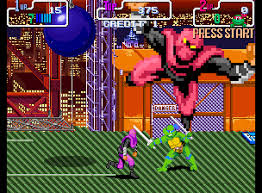
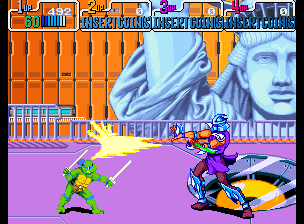
Beat ‘em ups never have very involved stories, but Turtles in Time at least makes an attempt to keep things interesting. They could have just been lazy and made the game a simple “save April from Shredder” type thing, but they didn’t. Instead, Turtles in Time focuses on Krang and Shredder as they steal the Statue of Liberty and bring it back to their lair. Things start out simple enough with you fighting through waves of Foot Soldiers in an attempt to stop them, but they quickly go south when Shredder sends the Turtles back in time through a time warp. The rest of the game consists of the Turtles fighting  through several time periods as they make their way back to the present day. Upon arriving back home, the Turtles defeat Shredder and save the day once again.


Gameplay:

If you’ve played the previous TMNT arcade game, you’ll know how this works. The mechanics are pretty much the same. You walk forward and you fight different-colored Foot Soldiers, each with their own unique abilities. You jump, you attack with your main weapon. I’m not exactly sure how they are triggered, but there are some special moves that are exclusive to this game, like the ability to throw your enemies at the camera or pound them into the ground back and forth like Hulk smashing Loki around in the first Avengers movie. Super cool stuff.

At the end of each stage you fight a boss. No Rocksteady and Bebop this time around, as this game has you squaring off with their live-action movie counterparts Tokka and Rahzar at the end of one of the levels. There are other lesser-known bosses unique to the cartoon that make appearances as well, like Cement Man and Leatherhead. There are some repeats, but I like how the bosses aren’t just all recycled from the first game. There’s a couple of surfboarding levels this time around too, one of them in the sewer and the other using hoverboards in the future.

I feel as if I don’t have much to say about this title’s gameplay. You walk forward and you fight things. This game doesn’t add much that wasn’t already seen in the first TMNT game. That’s not a bad thing though, as that game was a ton of fun, and this one is a blast as well. In fact, I’d say that technically this is probably the better of the two games.

I played on an emulator so I churned my way through this game pretty quickly. It’s amazing how easy this game is with an unlimited supply of virtual quarters. What was tough in the arcade is easy now. I’d say I beat this game in about 30 minutes, if that. The good news about this version of the game is that it is capable of four-player co-op. If you’ve got the friends and you’ve got a way to make this happen, I’d suggest going for it. This game is so much more fun when you’re playing it with someone else.


Graphics:

Man, I just love how this game looks. It is so true and authentic to the cartoon. I remember my eyes lighting up the first time I played this as a kid, and I have to say that the same thing probably happened this time around. It’s so bright and colorful. The characters look fantastic. The stages look fantastic. As I played this I was transported directly into the world of the cartoon, like it was the 1980s all over again.

Before I move on, kudos to the Wild West stage for giving me major Sunset Riders flashbacks, from the graphics to the music as well. Was that intentional on Konami’s part? I’d like to think so.


Sound:

Even better than the graphics may be this game’s music. As soon as this game started up, I was completely shocked and impressed that they used the “Pizza Power” song from the TMNT traveling rock tour as this game’s intro music.

SO.FREAKING.COOL.

I had  that cassette tape as a kid, and I listened to the songs on it over and over again. I had no idea that music from that cassette tape had made its way into a video game. No idea. Hearing that song was an absolute blast from the past.

The game’s stage music is fantastic as well, as are the sound effects and the occasional bit of voice acting. When it comes to production values, this may be the closest any TMNT game has come to recreating (or even surpassing) the magic of the cartoon series.


Overall:

I was impressed by my time with this game. It is an improvement over the original TMNT arcade game, no doubt. Everything about that game was taken and improved upon, from the music to the graphics the bosses and the stage design. As far as gameplay goes, there is not much new to see here and that ultimately is my main knock on the game. It attempts to make a few changes here and there with the extra moves you pull off, but really this game feels like more of the same. That’s not really a bad thing, as the first game was freaking awesome too. But a little part of me just wanted a little bit more from this game.

I’m torn on what final score I am going to assign this game. I gave the original TMNT an A-, and I said that this game was an improvement over that one, so you’d think it should get a higher score. But I don’t know. I can’t say with certainty that this is an A or A+ title, improvements or not. Yes, this game does a lot better than its predecessor, but at its core it delivers virtually the same experience. So I feel I have to give it the same score. Bam, problem solved.

Side note before I wrap up this review – I have heard that the SNES version of this game is even better than the arcade version, so I plan to visit it soon. Keep your eyes open for that review!


Final Score:
A-


If you liked this review, check out some of my other game reviews:

Friday, September 17, 2021

Video Game Review #295: DuckTales

DuckTales
Nintendo Entertainment System


Nostalgia Factor:

When I wrote my review for DuckTales Remastered about two and a half years (and 134 reviews) ago I remember being under the impression that I had played the original NES game in the past. I was wrong.

I came to the realization pretty quickly after starting this game that I had definitely never played it before. I guess it’s an easy mistake to make, considering the plethora of cartoon-based games that came out in the late 80s/early 90s like Chip ‘n Dale Rescue Rangers and Darkwing Duck. Still though, I find it kind of funny that I’d played the next-generation remaster of the game before playing the original 8-bit version. I am old - it almost always happens the other way around! 

Regardless, as soon as I started playing this game I realized it was something I was going to absolutely love, and lo and behold I was correct. Despite being made with technology that has been outdated for decades now, it completely blows the remastered version out of the water. Read on for my full review!


Story:

The game’s story is pretty thin. You play as Scrooge McDuck and it is your goal to collect five treasures from around the world in order to cement your status as the richest duck in the world. As you play you’ll battle through several of the cartoon’s famous villains as they attempt to stop you and steal the treasure for themselves. These villains include Flintheart Glomgold, Magica DeSpell, and the Beagle Boys.


Gameplay:

Right off the bat, DuckTales showcases its willingness to do something different by offering you a stage select screen. That’s right, you can play the levels in this game in any order you want (with a few stipulations). It is your goal in each stage to make it to the end of the level, fight a boss, and collect that stage’s treasure. Once you’ve collected that treasure, you go back to the stage select screen and make your next selection. The game doesn’t end once you complete all five stages – instead some of the villains team up in a desperate attempt to steal what is yours and you must fight them and defeat them to beat the game. All in all this is a pretty quick and easy game. Don’t expect to spend more than two hours on it your first time through it. I played through DuckTales twice before writing this review, and on my second playthrough I was able to cut my time playing the game completely in half. So it is definitely not a lengthy game.

I don’t want you to think it’s too easy though. I’m a grizzled 8-bit veteran who grew up playing stuff like this so I was able to pick this up and succeed at it pretty quickly. If you are not used to this type of game you might struggle with it for a while. I’d say the challenge level is just about right for the type of game this is.

Another thing that makes DuckTales different is in its level structure. For example in the first selectable stage, the Amazon, you’re cruising along thinking you are going to beat the stage when BAM you hit a “toll way” where you have to pay $30,000 to advance. If you don’t have the money you need to make it through, you have to turn around and start looking for more. This game is filled with stuff like that. Transylvania has magic mirrors that transport you around the stage, giving you multiple paths to take and adding a maze-like feel to the level. On the moon you have to collect keys and search the starship before you can summon Gizmo Duck to come help you. You need a key to even get into the African Mines stage, which you can find on a hidden pathway in Transylvania. So there’s all kinds of little touches when it comes to the stage design that make the game worth playing through and exploring as thoroughly as you possibly can.

Gameplay consists of your simple, side-scrolling affair. Controlling Scrooge McDuck, you jump, whack with your cane, and bounce your way through the game’s stages. Enemies hurt you if you touch them. You cannot jump on them or hit them directly with your cane or you will take damage. You have to either whack blocks at them with your cane or use your cane to bounce on their heads. Utilizing the cane bounce move is essential to mastering this game. To activate it, you jump and hit down and the action button at the same time. Hold the action button to continue bouncing. The second you let it go, however, you drop to your feet on the ground – so be very careful. You’ll use your bounce move to fight enemies, bounce across spikes, jump long spaces between platforms, and reach high places. You can control the height of your bounces by strategically letting go of the action button and deactivating and activating the bounce move in mid-air.

Collecting money in this game is a little different. Instead of breaking blocks or having shiny collectibles sitting out in the open, the gems you collect are completely invisible to you. By walking or jumping through their predetermined locations, you “activate” them and make them visible, where they fall to the ground waiting for you to collect them. It’s an interesting mechanic, but one you’ll get used to quite quickly.


Graphics:

I think this game looks really good. Of course it isn’t as vibrant and colorful as the remastered version, which looks like a cartoon brought to life, but it still looks pretty darn good. It has that classic NES charm to its visuals that is hard to deny. The stages are fun and well-designed. The characters look great. I got major Mega Man vibes from this game’s visuals as I was playing it – which I guess shouldn’t be too surprising seeing as how this game had a ton of people who worked on Mega Man on its creation team.

DuckTales for the NES pays a wonderful homage to the show, giving you occasional cameos from people like Launchpad McQuack, Webby, and Huey, Dewey, and Louie.


Sound:

This game sounds absolutely sensational as well. As if the 8-bit digitized version of the iconic DuckTales theme wasn’t enough, each stage has its own unique musical track and ALL of them are absolutely top-notch. My personal favorite is the music from the moon stage. It’s so freaking good! Again – major Mega Man vibes.


Overall:
 
I had SUCH a good time with this game, and I was not expecting it at all. Like I said before, I had already played the remastered version on the PS3 and while I liked  that game, it wasn’t anything I was too overly excited about. I ended up giving it a final score of a B. This game, however, is so much better. And it is so much better because it is so much simpler. No dialogue scenes that drag on for unnecessarily long amounts of time. No irrelevant back story to each stage. No “missions” or fetch quests to partake in. You just explore the level, find your way to the end of the stage, fight a boss, collect a treasure, and move on to the next level. Simple as that.

The game is flat out fun. A great control scheme, well-designed stages, great music and graphics, an intuitive “bounce on your cane” gameplay system, fantastic bosses. I could not put this game down. Usually I just play through a game one time before I review it, but I had such a great time with DuckTales I absolutely HAD to play through it twice. And I had just as much fun on my second playthough (if not more) than I did on my first. This is a game that gets better each time you play it.

Would I recommend DuckTales to anyone who hasn’t played it before? Absolutely! I always thought I’d already played the best games the NES had to offer, but with my recent playthroughs of games like Castlevania III, Kid Dracula, and now DuckTales I am realizing that even though I’ve played and reviewed 26 NES games now, I’ve likely barely scratched the surface of all the great games on the system.

Play this game. Play DuckTales. You are doing yourself a disservice if you don’t!


Final Score:
A


If you liked this review, check out some of my other game reviews: